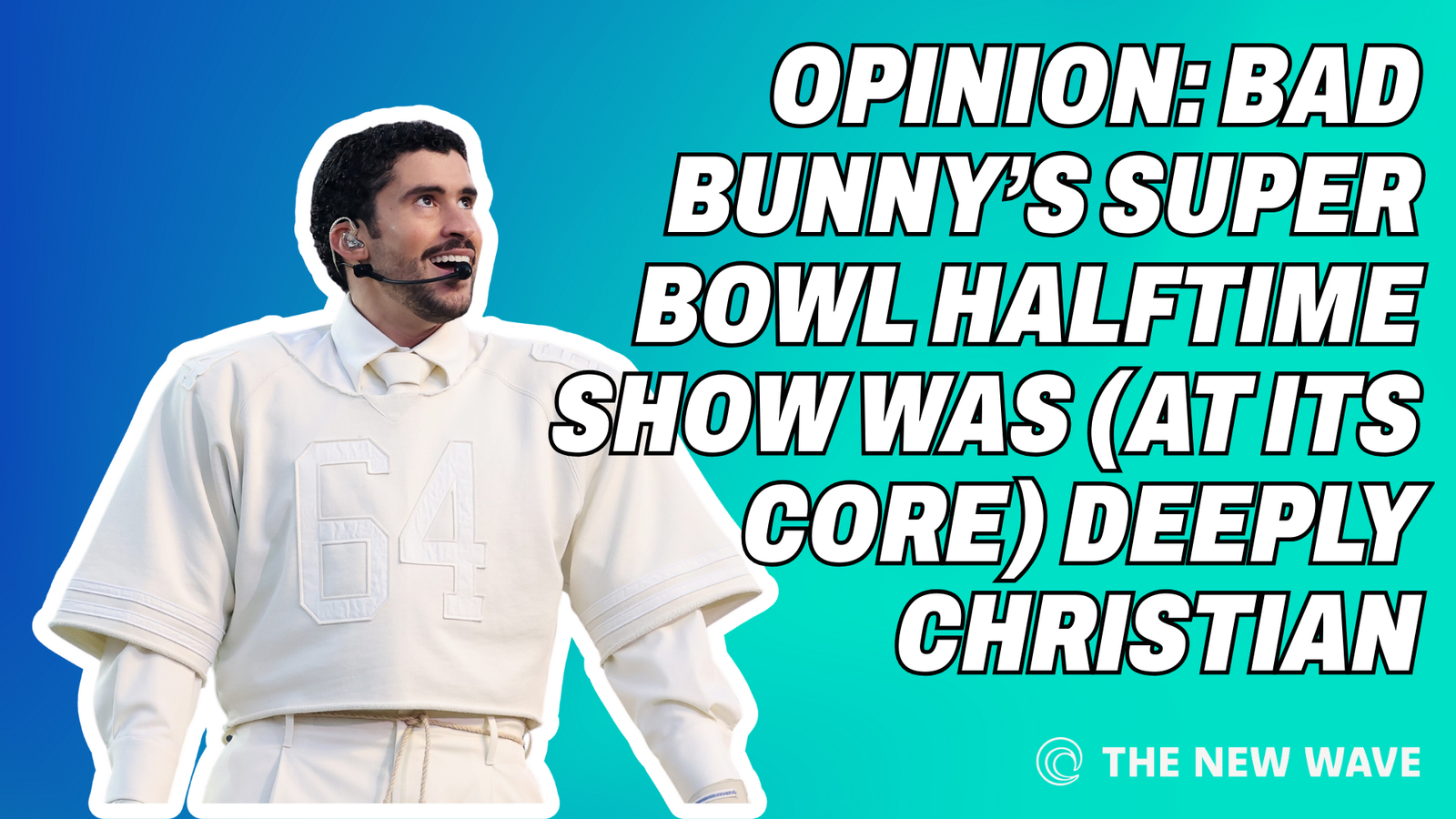
Opinion: Bad Bunny's Halftime Show Was (At Its Core) Deeply Christian
Without a doubt, the NFL Super Bowl is one of America's most iconic and widely practiced traditions… football is “America’s game” (though the league has recently been attempting to expand that audience) and Super Bowl Sunday is a time for people all over the country to gather in their living rooms with friends, family, and food. Even beyond the actual game, the ritual around this game goes deep: highly expensive ad slots are filled with celebrity appearances, billions of dollars are placed on anything from the coin flip to the color of Gatorade, and the halftime show has continued to grow into one of the highest achievements an artist could ever dream of reaching.
Speaking of the halftime show, it seems to me that, in American Christian homes, complaining about the performance has become as much of a tradition as the untouched veggie tray. To what extent this adversity has been justified in the past is an interesting conversation, but I’m going to save that conversation for another time and focus specifically on this year. Especially in the wake of TPUSA’s alternative halftime show and divisive conversation around everything, I think it would be beneficial to pause, look at what was actually said during the show, and think about what it means for America and for watching Christians. By the end of this article, I intend to lay out a case that Bad Bunny’s halftime show was not just tolerable by Christian standards, but was actually deeply Christian in its messaging and conclusion.
BAD BUNNY’S RELIGIOUS BACKGROUND
Before we dive into details of the show, it would be beneficial to talk a little bit about Bad Bunny’s (aka Benito Antonio Martínez Ocasio’s) personal history with Christianity. According to a number of sources, Benito was raised in a devout Catholic family in Puerto Rico, where he attended church frequently and sang in the choir on a regular basis. In interviews over the past few years, he has communicated a continued appreciation for Christianity, while distancing himself from organized practice, saying “God is everywhere, so why do I need to go to church?” In a 2024 interview, he is reported to have stated “I don't pray, but my family does it for me.” Some analyses of his music suggest Christian undertones, while many have critiqued his lyrics and persona to be contrary to Christian values. In his recent GRAMMY acceptance speech, he thanked God, which shows he has at least some form of belief in the God he grew up worshipping. Based on all of this, I believe it can be fairly said that Bad Bunny has a Christian background and a respect for the church, but is less directly involved in this faith as an adult.
What does this mean for us in this conversation? For one thing, I think it’s worth clarifying that I do not intend to argue that this halftime show was a direct profession of faith from Benito. It was not intentionally done for a Christian audience or for the explicit purpose of evangelism. Despite this, I think it would be a mistake to write this artist and this performance off completely. He clearly still has a large respect for the Church, holds to a belief in God, and spent his upbringing being influenced by Christian teaching. Even without all of these ties to religion, I still believe there would be a conversation here about where his messages align with Scripture, but I think that this background adds even more of an interesting layer to that.
One more concession to make before we dive in: this article is not a complete endorsement of every moment of the halftime show or everything Bad Bunny has ever said. In talking with some Christian friends, they made it clear that they were really put off by some of the more sexually suggestive dancing near the beginning of the performance. Additionally, Bad Bunny’s lyrics are occasionally explicit in nature and contain profanity or explicit themes. I am not denying this or saying that every moment of the show was Christian. I am not inviting believers into shrugging off conviction here… please keep your conviction. What I am inviting believers into is being open to being pointed to Christ and His truth through the bigger picture of the show. If all creation points to the creator amidst its flaws, I don’t think it’s crazy to say that a halftime show could as well.
3 KEY DEEPLY CHRISTIAN THEMES
While watching the halftime show, there were three very central parts of the show that I was really drawn to, and that each, in my opinion, can point us to Truth.
THE (REAL) WEDDING
A few minutes into the performance, the camera cuts away from Bad Bunny to show a wedding scene, followed by a moving performance by Lady Gaga of a Latin rendition of her song “Die With A Smile.” This takes place in what is clearly designed to represent a wedding reception, complete with a wedding cake, dancing, and a kid asleep on chairs in the corner. According to a few sources I found, this was actually a real wedding that took place during the performance, complete with an ordained Sacramento pastor officiating the wedding, which I think was a really cool choice to include, as well as an extremely unique and special moment for the couple.
It’d be hard to say this wasn’t a sweet moment, but what does this have to do with the potential Christian-ness of this performance? As I mentioned above, this was a literal wedding ceremony, led by a Christian pastor… so at its very core, this moment was a literal embodiment of Christian practices that date back thousands of years. Scripture even talks about marriage being a picture of Jesus’ future union with His people... it is an act that can never (as much as some try) be separated from God's promises. While I’m not claiming Bad Bunny and his team were making a profound claim about the future of the Church or anything like that, I think the inclusion of this wedding does, at the very least, show that Benito values the institution of marriage enough to have it as a centerpiece of his performance, and it can still remind us of what marriage is supposed to remind us of, no matter the intent.
LOVE > HATE
On a billboard at the end of the performance, in English letters large enough to see in every photo taken of the moment, Bad Bunny chose to proclaim to the world “THE ONLY THING MORE POWERFUL THAN HATE IS LOVE.” This is undeniably a DEEPLY Christian truth… and here’s some Scripture that parallels this claim.
I love that this was his message that Benito wanted to leave to the world… not one of antagonism or any kind of us-vs-them mentality, but one of love triumphing over hatred. No matter your political, or even religious, persuasion, I think this is something everyone can and should be able to get behind. It concedes that hatred is powerful (no one who pays attention to history or recent news can deny that), but also that the only thing that can triumph over evil is love. Two thousand years ago, a Jewish teacher named Jesus flipped the world on its head with that same claim and died to prove it. This claim at the end of this performance, at the very least, is an invitation for any Christians watching to look at themselves and evaluate: ‘am I living out this love that triumphs over hatred?’
“GOD BLESS AMERICA”
While the aforementioned statement was broadcasted over the stadium, Bad Bunny finished out his performance by saying, in English, “God bless America,” and then proceed to list nations in South and North America. In this, he seems to be claiming that all of these countries are “America,” and that when he says “God bless America,” he is asking God to bless all of the American countries, not just the USA.
I’ve heard a good amount of people take this, and the performance as a whole, as a sign of contempt and disrespect for the Red, White, and Blue. It is undoubtedly a political statement because it involves geo-politics and surrounding nations, and it would be ignorant to say that this wasn’t in any way meant to call out the political views that some Americans hold. In my opinion though, this is not meant to be a dig at the country as a whole, so much as a reminder that there are many kinds of people held within the country, and that speaking a language other than English or being of a descent that is not European does not make these people any less American. His claim is not that Spanish-speaking people are better or more blessed by God, but that they deserve the same respect and the same blessing as those that fit the typical “American” typecast.
CONCLUSION
As I reach the end of this article after analyzing the end of the performance, it feels only fitting that I would try to connect it to the end of the Bible and God’s plan for humanity (aka the Gospel). The very last scene of Bad Bunny’s halftime show shows people representing all of the nations that constitute “America” dancing together, all with massive smiles on their faces. As the show faded, I couldn’t help but think of Jesus’ mandate to make “disciples of all nations” in the Great Commission, as well as the picture in Revelation where “every tribe and language and people and nation” worship the Lord together.
“Worthy are you to take the scroll
and to open its seals,
for you were slain, and by your blood you ransomed people for God
from every tribe and language and people and nation,
and you have made them a kingdom and priests to our God,
and they shall reign on the earth.” Revelation 5:9-10
This scene at the end of the halftime show is in no way a perfect representation of “every tribe, nation, and tongue,” but the intentional diversity of the moment, at least to me, is a beautiful picture of that scene at the end of time. In being reminded of this Scripture through the halftime show, I had an interesting, and somewhat provocative, thought: heaven will not be very American. What I mean is this: heaven will have former American citizens in it, but we will only make up a tiny percentage of the people there. God’s plan is to redeem people of every background throughout history, and for us to come together in perfect harmony at the second coming of Christ, singing in an infinite number of languages from an infinite number of nations. In light of this, I think it’s safe to say that the wedding reception after the final union of Christ and the Church will look a lot more like a Bad Bunny mosh pit than a Kid Rock concert, and I, for one, am thanking God for that.

Drew Kedersha
Drew Kedersha is the founder of The New Wave, a platform highlighting boundary-pushing Christian music. Currently based in Nashville, TN, Drew spends his time writing music, listening to a lot of podcasts, and going to class occasionally. Mostly, he just wants the good stuff to get heard.