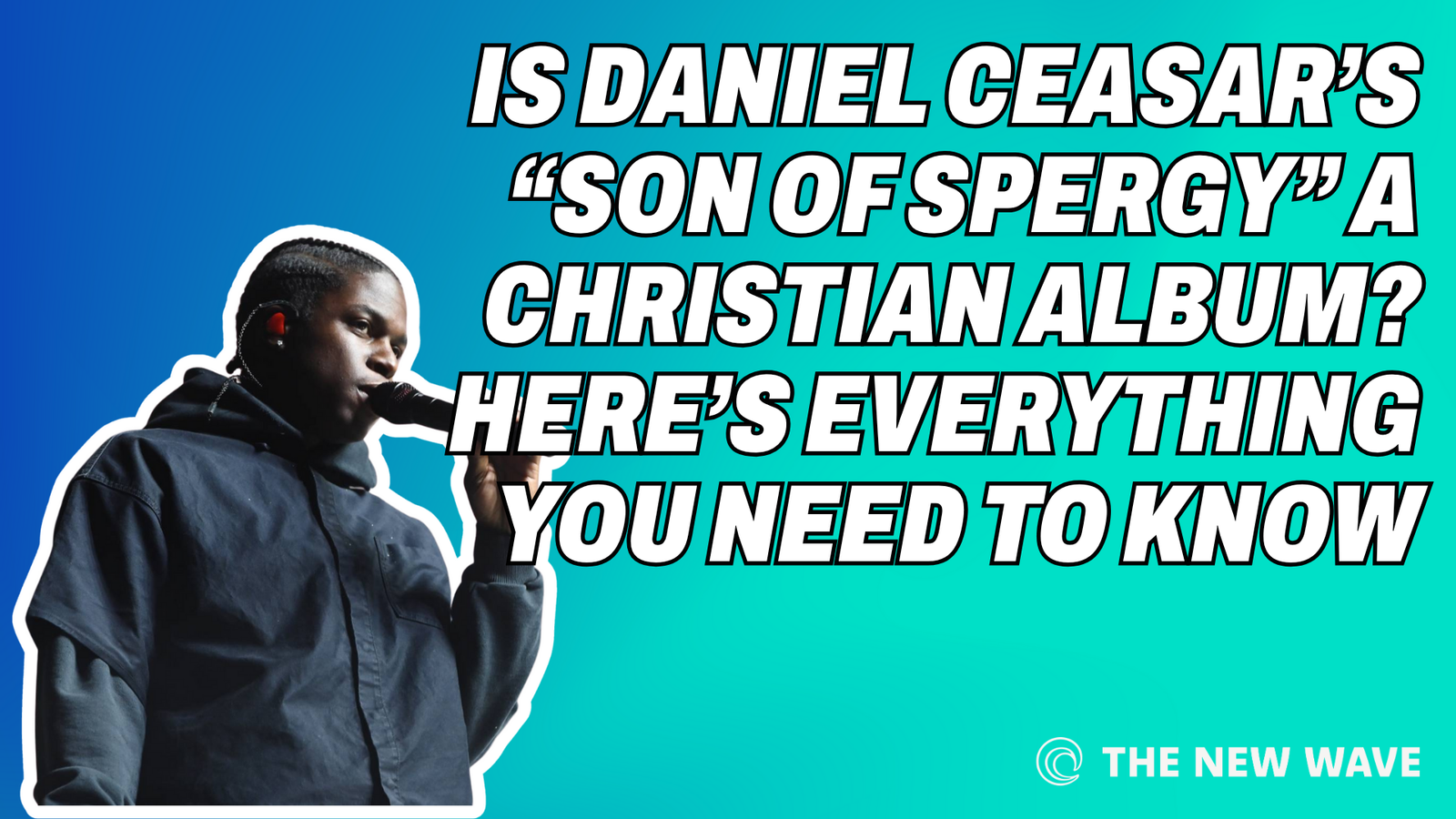
Is Daniel Ceasar's "Son of Spergy" a Christian Album? Here's Everything You Need To Know
Listening to Daniel Ceasar has always felt like a “religious” experience for me, but on his newly released album Son of Spergy, that feeling has been taken to new heights.
If you’ve been following the rollout or have listened to much of the album, you understand why: from start to finish, this has been an era that has been undeniably surrounded by Christian imagery and themes. From Bible verses quoted at pop-up shows to an album release show set in a cathedral (backed by a choir dressed as clergy) to track after track of gospel-inspired lyrics and sonics, it is undeniable that this album is related to Jesus and the church.
The discourse around this project that I’ve seen, especially related to how this project connects to faith, has been fascinating. Though there are Christians that are Daniel Caesar fans (ie. me), his music has been pretty much exclusively non-religious, dealing primarily with concepts of love and loss, and sonically, he leans much more alternative R&B than CCM… much more Frank Ocean than Forrest Frank. So we’ve got old Daniel Caesar fans and new Christian listeners that are intrigued by the themes, all across the spectrum of typical music taste and theological leaning, all discussing the same project, and pulling wildly different conclusions and what the album is about.
In all of this conversation, one obvious question has risen to the top in most spaces… is Daniel Ceasar’s Son of Spergy album a CHRISTIAN album? I’ve seen non-Christian fans say it is. I’ve seen non-Christian fans say it isn’t. I’ve heard Christian listeners say it is (though most have said it isn’t). If you’re asking the same question, welcome… you’ve made it to the right place. Through the rest of this article, we’re going to take some time diving into the backstory, rollout, and themes on the album, and by the end of it, I intend to make a claim on whether this project is “Christian” or not. But first…
WHAT IS A “CHRISTIAN” ALBUM?
To some people, the answer to this might be obvious and not worth spending time on, but I think there’s some fascinating nuance in here that is extremely important to this discussion. Is an album Christian because it is made by a Christian artist? Not inherently… plenty of Christians have made music without clear Christian themes that most wouldn’t deem obviously “Christian.” So do Christian themes make an album Christian? This is also muddy, because there have been plenty of albums, such as Kanye West’s “The Life of Pablo” that have discussed faith, but would (for many fair reasons) not land with a Christian audience. So is an album Christian when it is made for a Christian audience? This is the distinction that the Christian music industry tends to land on… Christian labels sign Christian artists that make Christian music for Christian listeners. To me though, this definition is very limiting on what Christian music can be. What if an album is about God, but doesn’t sound like typical Christian music, not appealing to the typical CCM audience? Does that make the album not Christian? Absolutely not.
I’ve spent a lot of time thinking about this, and with all of the above nuances taken into account, here’s a definition that I’ve landed on (feel free to disagree, but for the sake of the rest of this article, I think a landing spot is needed). To me an album can be considered Christian when the project is made either for a Christian audience or for a Christ audience. If an album is made primarily for the defined Christian market, that is easy to define as “Christian.” But to me, even if an album lands primarily with a non-Christian audience, it can still be considered Christian if it was made with the goal of glorifying God or making Him known.
This album was not marketed towards the typical Christian market. It doesn’t sound like mainstream worship or gospel (at least as a whole), the lyrics are too poetic to be palatable for Christian audiences used to “positive and encouraging” music, and Ceasar likely will not be making an appearance at the Dove Awards. So this album wasn’t made inherently for Christians… but was it made for Christ? In the process of writing this album, is Ceasar making any kind of statement about God? Is he trying to bring Him glory? As we go through the album and everything around it, these are the questions we will be trying to answer.
SOME CONTEXT
In talking about this project and rollout, the obvious place to start is the namesake of the project: Norwill “Spergy” Simmonds, Caesar’s father. Their relationship has been at the forefront of this album from the very beginning: in a heartfelt Instagram post that started the albums rollout, Daniel reflected on his relationship with his dad, laying out his origin story: how he had started as a singer in Jamaica, had been brought to Canada by the Adventist church, and how he would stay there and start a family. What might at face value seem like a random story is at the center of this album: Daniel’s relationship with God has been intertwined with his relationship with his dad. In it, he made a profound claim that shouldn’t be missed, saying “We resent the cliches of our parents until we become them. I am now the herald all I refused to believe in.” Here, Caesar points to his resistance to his parent’s faith, and how he is now proclaiming that same truth he once ran from.
References to his parent’s faith and its effect on him didn’t stop with this post. Leading up to the release of the album, Caesar embarked on an innovative pop-up show journey, dropping coordinates for stripped back album rollout shows in parks hours before the performance. Thousands would show up to hear Daniel perform his music, using nothing but a PA system and a guitar. At one performance, he talked briefly about his dad, saying that he “wanted to share God with me—that was the most important thing to him.” He then detailed how he had rebelled against God and his father, and then turned back, saying that he “needed them both for very similar reasons… they both kind of operate as your protector and your lover—your lover of your soul.” In the same monologue, said the album was “like I was drawing myself a roadmap back to God. And almost like a roadmap back to the thing that connected me and my father as well… making this record was very healing for our relationship.” Later in the show, he quoted Jeremiah 29:11, saying that he has recently been grounded in the truth of God’s plan for his life.
There are plenty of other details to dive into in the rollout and in Daniel’s relationship with his father, but for the sake of time, we’ll dive into the music and what is actually being said. If you’re curious about that, scroll through his IG and check out this fantastic interview for more insight directly from Ceasar on faith and family. It’s time for the fun part though…
SOME SONGS
As I’ve done with other album breakdowns, I plan to dive into each song, writing about the key themes, sonics, and lines that stand out. On this album more than others though, I want to lean into the order of the project and the overall story being told, because I think it would be a miss to just think about these songs without the context of the surrounding story. Caesar has had previous albums that are undeniably conceptual, telling a larger narrative as the songs go one, and I believe that this album continues that legacy. Because of that, I am going to talk about individual songs, and then share a few thoughts about how it might fit into the story of the album as a whole.
Rain Down (ft. Sampha)
From the very beginning track of this album, faith-inspired sounds and lyrics are undeniable. To me, this song serves as an intro to the project: piano and gospel-sounding vocals weave in and out in a powerful way, and a plea to God is repeated throughout the track.
Have a Baby (With Me)
In this beautiful track, Caesar sings to a woman who is physically present, but seems distracted and distant… the end of the relationship seems to be imminent, but the singer pleads for her to think about what they could be.
I’ve seen a few people point to this song as evidence that this isn’t a Christian record because of its sexual nature, but I think that would be a miss. There are a few ways this could be interpreted, and I think that none of them negate the possibility that this album is about God in some form or fashion. Option 1: the song is from Daniel’s perspective, singing to a lover, asking for immediate intimacy. I will acknowledge that this is the most obvious interpretation and goes against a Biblical understanding of sex, but even if this is the intention of what the song is about, I think it would more so show a lack of spiritual maturity in Ceasar’s life (especially considering he has only recently returned to the faith), rather than a sign that he actually doesn’t know God and is choosing to disrespect Him.
Option 2: Ceasar is not just pleading for intimacy, but for the woman to move past temporary issues and consider getting married and starting a family with him. This is shown in lines from the second verse:
In God, this world, in Hell, and all the things that this could be?”
In this context, Ceasar’s plea to have a baby is no longer a desire for pre-marital intimacy, but is rather a God honoring desire to promise his life to her, be intimate, and start a family.
Option 3: This song is intended to capture Ceasar’s father’s perspective and experience in falling in love with his mother. This might be a stretch, but I think there’s a good amount of evidence here and in future songs. The album as a whole is about “Spergy,” and if this album is about their relationship, it would make sense to have some of the project be telling Spergy’s story, and what better place to start than Daniel’s own conception?
African woman, you're the one I adore
I-I-I need you, like never before
I'll give you all I've got, and I'm sure”
Call On Me
Following Ceasar’s (and/or Spergy’s) plea for intimacy and a future, the narrator of the album continues to sing to his lover, this time backed by more driving drums and distorted guitars. Just like the previous song, it isn’t explicitly about God in the way that the opening track is, but it does serve to continue to serve the story of the album by furthering the relationship introduced on the last song. In it, the issues from the previous track have been alleviated:
Comfortably inside of my arms”
In this place of safety, the singer promises that he is willing to give his lover whatever she needs. As mentioned before, this song could be interpreted as Daniel singing to a lover, or his father singing to his mother.
Baby Blue (ft. Norwill Simmonds)
After the upbeat, driven atmosphere of the last song, Caesar strips back down to guitar and beautifully layered vocals for another sweet ballad of love. The lyrics are poetic and pretty vague, so they could be interpreted multiple ways. It could be Ceasar and/or Spergy singing to a lover, continuing the themes of the last few songs. Though there’s no way to know for sure, it’s my belief that this song is actually from the perspective of Spergy TO Ceasar, capturing Daniel’s birth and Spergy’s newfound love and dedication to him. The title and refrain “Baby Blue” backs this up… it literally has the word “baby” in the title, and the color “blue” is symbolic of a male child, ie. baby Ceasar.
I'm privileged to know you
And from this point on, your delight is my delight”
The song ends with a recording of “Spergy” himself, Daniel’s father Norwill Simmonds backed by a Gospel choir singing about Jesus. If anyone forgot by this point of the album that God is a key theme of the project, Ceasar and Spergy remind them of it here.
Root of All Evil
In this song, Caesar breaks away from the love ballads and sings more explicitly about his faith in God and fight against temptation while trying to follow God. The title of the track, and many lines in the song, directly reference a verse about sin in the book of 1 Timothy.
Proclivity to evil
I know that I've gone astray, here I am
So many pretty people”
Throughout the track, Caesar acknowledges his sinful nature and expresses a desire to break free from the vices holding him captive.
Somebody please discipline me
For I'm a sinner, a sinner"
Who Knows
In this track, Caesar returns to singing to his lover, but with a shifted perspective based out of the insecurity from the previous song. He loves this girl, but is insecure and unsure about it, stating that he thinks she is too good for him.
Hiding in a disguise of an ever-giving flower
Incompetent steward of all of that sweet, sweet power”
He has acknowledged his own sinful nature on “Root Of All Evil,” and wonders if it's even fair for him to continue to pursue someone that is so much more mature and pure than he is.
In time, we'll find if it's sustainable
You're pure, you're kind, mature, divine
You might be too good for me, unattainable”
Moon (ft. Bon Iver)
In this song, Caesar continues to express love for his partner from this place of brokenness and insecurity. He starts off by acknowledging that he isn’t where he wants to be:
Maybe soon”
In his brokenness, he states that the only way he knows how to show his love is to fight and be an advocate for her. In this desire to fight though, he feels inadequate, and asks who’s going to fight for him and protect him.
That ain't sustainable (You leave when you get to know me)
Who's gonna fight for me? Who will advocate?
Who's gonna be my Jesus?”
At the back half of this song, Daniel slows down and acknowledges the cycle of violence and weaponry around him, and how he himself is a part of it. He expresses a desire to leave that behind in the name of love. At this point in the album, he has acknowledged his brokenness and need for a protector, but hasn’t quite found it yet.
Man is but a pile of dust
Why are you a weapon formed up against me?
Is this what you call love?
Someday I will leave your home
I'll bе a man, I'll make my own
And I'll set this world on fire, you can't stop mе
There I will rest my bones”
Touching God (ft. Yebba & Blood Orange)
In this song, Daniel continues to feel the weight of the world, and finally turns to plead with God in the brokenness. He feels unheard and lost, and in a beautiful moment of vulnerability, brings this forward in complete honesty.
I know you made me, but I hate myself”
In the bridge, singer Devonté Hynes directly quotes 1 Corinthians, which says:
By including this, Daniel is acknowledging his own immaturity and childishness, a low right before resolution. As the song ends singer YEBBA provides a moment of beautiful worship, which I believe exemplifies a final surrender to God and a major turning point in the album.
Thy kingdom come
Yes, you're an awesome God
Thy will be done
Oh, Lord
The battle is won
On Earth and Heaven
Praised be the Son”
Sign of the Times
After this moment of plea and surrender to God, Caesar is back with his lover, thinking about intimacy in the context of his new relationship with God. While they are together, desire strikes again, but this time, something is different:
I'm stronger now than I used to be”
After this scene, Caesar begins to reflect on his life, acknowledging his need to be rooted in his faith. He talks about chasing around a girl for pleasure, but then being delivered, comparing this salvation to the Israelite’s escape from Egypt.
I was chasing 'round my f***in’ lady like a sycophant
But you brought me up and out of Egypt with your single hand”
He then describes a friend’s car crash, and his gratefulness to God that his friend escaped alive. In reflecting on this, He interprets it as a sign from God that he is just now realizing.
Emily’s Song
In this song, Caesar sings to a previous lover named Emily, singing to her in a beautiful and complex way that captures the fallout of a beautiful and complex relationship. In the song, Daniel works to acknowledge both the fantastic parts of the relationship and the hurtful ones in a stunning and nuanced way. On the positive side, he talks about how this girl helped him learn a lot about himself in ways that he had never seen before.
For being my mirror
Showing me myself
I just want to thank you
You help me see clearer
Like nobody else”
In contrast, Caesar says that time away from Emily has helped him to see that this relationship was also an addiction that he will never go back to.
And I got a bit of clarity
Addicts are addicts and will never change”
In the context of the story of this album so far, I think this track serves as a well crafted reflection on how love for him in the past exposed his flaws and served as a vice that he wants to be wary of now that he is following God.
No More Loving (On Women I Don’t Love) (ft. 646yf4t)
In this track, Caesar makes his distancing from unhealthy, lustful relationships clear, singing that he is done “loving on women I don’t love.”
At the end of the song, artist 646yf4t directly quotes Psalm 23, singing about being able to trust God even when surrounded by death and temptation.
Sins of the Father (ft. Bon Iver)
Daniel closes out the album with a beautiful reflection on his relationship with both his Heavenly, perfect Father (God) and his Earthly, imperfect father (Spergy).
In verses 1 and 2, Caesar lays out the hurt and sin that his parents had laid on him in his early life and relationships with them.
My mom and my daddy, upon me they've placed
I have no words to say
It's written there all over my face"
I can't be at home where my father lays
In time we'll fade away
Hopefully it's to the same place"
In verses 3 and 4, Caesar turns to God, praising him for being the perfect loving Father that his own father never could be.
Like my own never could
How could I ever thank Thee?
You are good”
You gave Your life so I wouldn't have to
Whеre there is onе, there's two
It's me and You”
In the bridge, Caesar acknowledges his need to release the hate in his heart and be transformed by God.
But I got no place to put it
Tried to leave it behind but I couldn't
I need alchemical transmutation”
At the end of this song, we find that Daniel finds the ability to forgive his earthly father for shortcomings and “sins” through understanding God’s forgiveness. As the song ends, Justin Vernon (aka Bon Iver) sings about Spergy’s sins, and captures God’s plea towards Caesar and humanity to turn around, repent from sin, and come to God.
SOME THOUGHTS
So with ALL of that being said… is Son of Spergy a Christian album?
In the days since starting this article (yes this has been taking a while), I’ve seen some people argue that this album isn’t about God because it’s about Daniel’s father, just using Christian sounds and metaphors. Is it about love? Is it about lust? Is it just about Spergy? Is it about God? Based on the time I’ve spent with the project, I can say confidently that this album isn’t about one of those things, but the intersection of all of them. It’s 1000% about Spergy, following his falling in love and having Daniel, detailing his relationship with Ceasar, and identifying “sins of the father” that Ceasar has forgiven him for. It’s about love and lust, and the relationship between that in the context of turning to God. And yes, I am of the belief that this album, from start to finish, is at its core about God and Caesar's relationship with Him.
If you follow the narrative we laid out, God is the key focus of the very first moment of the album in "Rain Down,” showing that this is anything but “just being about Spergy with spiritual themes.” It dives into Ceasar (and/or Spergy’s) relationship with a lover, but then proceeds to show how that relationship and its unhealth is brought to the light by a surrendering moment to God. In the core of this project is the Gospel itself: we are broken without God, but as soon as we turn to Him, He exposes that brokenness and heals us from it. You’ve made it to the end, so here’s my answer: Son of Spergy is without a doubt a Christian album.
But what about the profanity and the sexual content? How can this be a Christian project if it isn’t clean? I think these are fantastic questions to ask, but only if we are willing to really listen for an answer, instead of using them to just write off artists that make us confused or uncomfortable. In reference to the sexual content: this album is extremely tame in terms of lustful words and desire, but when it is there, I believe that is included for the purpose of showing the temptations and addiction that Ceasar is trying to free himself of. As for the profanity: I’ve seen comments that think it contradicts the Christian themes, and ultimately I agree that leaving them out would have fit the redemption arc of the project better. To me though, this doesn’t invalidate the Christ-centered themes of the album, but instead deepens it. They show that Daniel is a younger believer, still being sanctified, but still choosing to turn to God and make music about Him in his imperfection. Caesar doesn’t feel the need to be perfect for God, but instead chooses to tell his story in an imperfect way as an imperfect human.
CONCLUSION
Ceasar is not the first artist to start off as a “secular” artist that finds God and decides to share something about it. In discerning how Christians should respond to it, I can’t think of a better place to turn than that of a recent secular-turned-sacred artist, Kanye West. In a similar, but significantly more dramatic way, Kanye had a massive rise in music, only to find himself turning to God and making music for Him. How did Christians respond to this supposed conversion? In his album “Jesus Is King,” Ye uses the song “Hands On” to detail their response:
What have you been hearin' from the Christians?
They'll be the first one to judge me
Make it feel like nobody love me”
But if I try to lead you to Jesus
We get called halfway believers
Only halfway read Ephesians
Only if they knew what I knew, uh
I was never new 'til I knew of
True and living God, Yeshua
The true and living”
Now obviously, this album has not aged well when compared to Ye’s recent trajectory… it's clear to anyone paying any attention that Kanye is no longer following God or anything that God says is right. I loved Ye’s Christian albums and learned a lot from them, and have grieved his downfall into hatred and insanity, and have often thought through what went wrong. I think this song gives us a clue, and wisdom into how we can prevent the same thing from happening. When Ye started to express a desire to follow God, many Christian’s doubted his conversion and pushed him away. In his early days of trying to give his life to God, he was met with hate and doubt. Though Ye has not explicitly said this, I believe that it is at least part of the reason he didn’t stick around. Christian’s expected perfection from him, when really what he needed was grace and room to wrestle.
Caesar is in a similar spot to Kanye during his “Jesus is King” era, and as Christians, I think there is an invitation in this parallel to be more intentional with our response. Caesar’s conversion and interest in faith seems genuine, and as believers we can either pour fuel on the fire or stomp on it and put it out. Instead of pointing out all the reasons Daniel might not be following Jesus perfectly, we can seek to understand and celebrate the positive life change in his life. We can pray for Daniel, as I’m sure his father has many times, and be expectant for what the Lord can do in and through his journey. That’s what I’ll be doing, and I invite you to do the same.

Drew Kedersha
Drew Kedersha is the founder of The New Wave, a platform highlighting boundary-pushing Christian music. Currently based in Nashville, TN, Drew spends his time writing music, listening to a lot of podcasts, and going to class occasionally. Mostly, he just wants the good stuff to get heard.