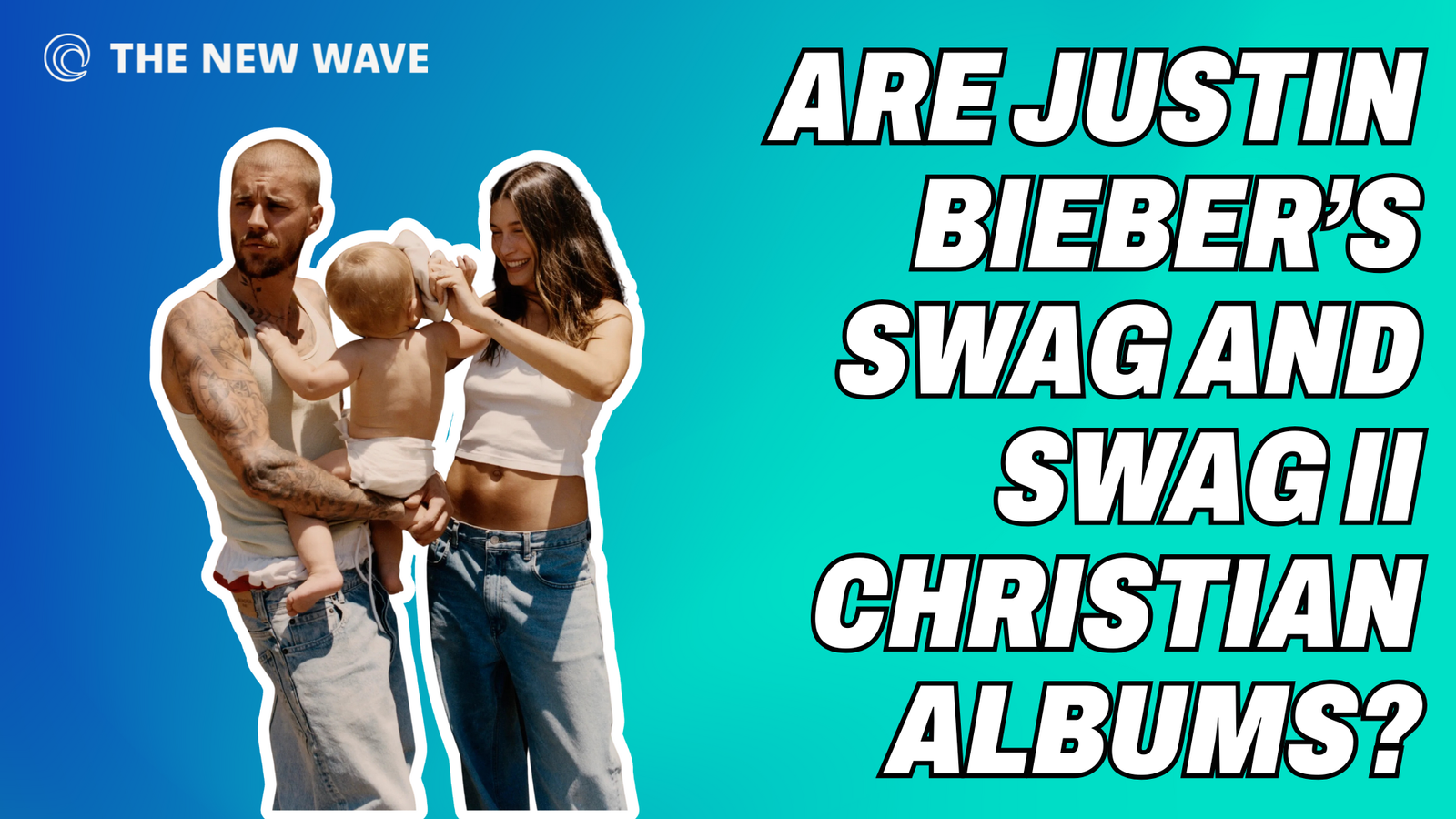
Are Justin Bieber's "SWAG" and "SWAG II" Christian Albums?
A strange promise with us would whisper from God about a coming Savior
Someone who would crush the serpent’s head
The door to the Garden was closed
But the story of God, it was just the beginning”
These are the final lines of the last track, “STORY OF GOD,” on Justin Bieber’s new album SWAG II—a powerful close to an entire track of poetic, spoken retelling of Genesis 3: the moment Adam and Eve chose to listen to the serpent, disobey God, and eat from the tree He told them not to. Ending his two-part, 44-track project SWAG with such a clear statement of faith is definitely a choice—and not something an artist does without a lot of thought.
To be honest, I thought the delivery was beautiful, but it left me with more questions than answers: why did Justin choose to include this here? Are there other moments of faith being declared on these two albums? Is there an overall narrative that makes this kind of ending fit? How do I hold in tension both the faith-related songs and the songs that seem to run against what God would want? Does this make SWAG a “Christian album”? Does it mean Justin Bieber is a “Christian artist”?
I don’t promise direct answers to all of these questions, but I do want to explore some potential answers and invite you to do your own thinking and wrestling. Below, I’ll give some context on Bieber’s faith journey leading up to SWAG and SWAG II, look into tracks that clearly draw on his faith, and talk about what I think we can take from them.
Some background
Bieber’s faith has been a consistent influence since his youth. He was baptized by Hillsong pastor Carl Lentz in 2014 and has openly described himself as a “Jesus follower” who prays regularly and is led by the Holy Spirit. His two previous full-length albums, Purpose and Justice, are primarily pop-leaning sonically and lyrically, but they do occasionally dip into faith-related themes. In 2021, Bieber released a gospel-inspired project, Freedom EP, which was his last release other than a few singles.
Since then, though, things have been messy. He canceled his Justice World Tour midway through, citing health and exhaustion. His social media presence has swung between vulnerable, strange, and sometimes concerning. And, of course, his connection to Hillsong pastor Carl Lentz—once a spiritual mentor—was complicated by the church’s scandal and fallout. Spiritually, it’s felt like Bieber has been quieter and harder to read, caught between moments of public faith and long stretches of silence.
That’s why SWAG and SWAG II feel so fascinating to me. They’re the first major projects we’ve heard from him in years, and they carry the weight of all that life lived in between—marriage, struggle, faith, and the question of what’s next for Justin Bieber’s walk with God.
Some songs
After finishing SWAG II and sitting down to write, the first thing I did was skim both albums to track down any songs that could be interpreted as obviously “Christian.” Out of the 44 songs across the two albums, only five landed in that category for me. I’ll dive into what that means for the releases as a whole, but first let’s look at what each of these songs is saying—and how they give us a glimpse into Bieber’s walk with God.
GLORY VOICE MEMO
Even though this track feels more like an interlude—short and unpolished—it’s been one of my favorites since release. It sounds like a voice memo from a jam session: guitar, keys, drums, and Bieber riffing and praising God over it. The whole thing feels very Psalm-like: describe the hardship, cry for mercy, end with adoration.
I been let down and stalled out
Trip out, then I fall down, screaming out
But I, I reach out my hands, I'm beggin' You for mercy
Please, Lord, would You take me?
So I reach out, uh, singing, "Glory"
Singing, "Glory to the King"
Singing, "Glory, Glory to the Most High"
FORGIVENESS
This is the 21st and final track on SWAG, sung not by Bieber but by Marvin Winans, an American pastor and gospel singer. Genius notes it appears to be a modified recording of a viral worship moment from August 2024. After a journey through many sounds and lyrics on SWAG, this closing thought is a moment given to God.
From the Earth to the cross, my sinful debt to pay
From the cross to the grave, from the grave to the sky
And Lord, I lift Your name on high
SAFE SPACE
A peaceful, somber moment near the end of SWAG II and a clear sequel to “DADZ LOVE,” featuring Lil B and a trance-like beat that breaks in halfway through. I can’t tell if Bieber is singing to someone else (his kid or wife) or if he’s channeling God’s voice singing to Bieber, but the lyrics clearly orbit comfort and prayer.
I'm open, you're more than enough
(I wanna listen, wanna listen)
I say a prayer (And I need it, uh)
EVERYTHING HALLELUJAH
In the second-to-last track of SWAG II (and the last song on both albums), Bieber strips the R&B/experimental palette back to acoustic guitar and simple vocals. It’s a sweet, beautiful song where everyday scenes overwhelm his words—so he lifts them up in simple praise.
It's beautiful, hallelujah
It's rainin' hallelujah
Breathe the air, hallelujah
I'm singin' like hallelujah
Dancin' like hallelujah
STORY OF GOD
As mentioned at the start, the final track on SWAG II is not a song at all; it’s an almost eight-minute poetic retelling of “The Fall.” It’s stunning and well-written. Bieber steps into Adam’s feet and imagines Genesis 1–3 in first person: the beauty of the garden, the awe of Eve, the atmosphere-shifting presence of God, the serpent’s temptation, the blame-shifting, the curse, and exile. It ends as God’s own “punishments” do—in promise.
"The woman you gave me, I blame her? I blame him?"
And I point to the serpent, "He tricked me"
The blame shifts faster and faster, we throw responsibility anywhere but ourselves
And the verdict comes down, the world is broken now, because we broke it
Some thoughts
So why did Justin include these songs? I think the answer lies in a bigger one: why include any of these songs—or release the album at all? To me, the answer seems frustrating but accurate: he included them because he felt like it. I know that’s annoying, but stick with me; I think it says a lot about where Bieber is emotionally, artistically, and spiritually.
I read that Bieber recently cut ties with longtime manager Scooter Braun, and that the split gave him unprecedented creative freedom. This happens a lot when artists leave a label or step away from guardrails: they release whatever they want, whenever they want. Anyone following “Lil Bieber” on Instagram knows he’s been in a mood of posting literally anything without polish or explanation—and it’s pretty clear SWAG and SWAG II are extensions of that rebellious, chaotic energy. While I wish I could claim these projects are extremely intentional and that placing the faith tracks at the end was a carefully plotted narrative move, it feels more likely Bieber wanted to make a statement about his faith—and didn’t overthink placing it at the end of a chaotic tracklist.
What do we do with the cognitive dissonance of faith-inspired songs dropped alongside songs that feel indirectly or directly un-Christian? Any time a “secular” artist expresses faith or releases a “Christian” song, the quick response is often, “But he curses,” or “But he smokes weed,” as if that disproves the faith entirely. To be fair, there’s some merit to the impulse; followers of Jesus should be working to cut out obvious sin. I also wish the album didn’t have eyebrow-raising moments. But I don’t think that invalidates Bieber’s professions of faith or makes them less powerful. Bieber hasn’t arrived at perfection, and neither have I. While both of us are in process—being sanctified and seeing the gravity of unaddressed habits—I’m grateful he’s let me learn from his Scripture-soaked insights and worship God alongside him.
So, are SWAG and SWAG II “Christian albums”? Is Justin Bieber a “Christian artist”? I think the answers depend on how you define those terms. My temporary definition: a song/album/artist can be called “Christian” if its purpose is either to appeal to a primarily Christian audience or to bring a non-Christian audience closer to God in any way.
Working with that, I don’t think SWAG or SWAG II are “Christian albums.” While they have moments that point to Jesus, the overall purpose seems more about expression and creative liberation for Bieber.
Despite that, I’d argue Bieber is a Christian artist. I don’t know him, but I’ve watched his faith journey in and around his music since he began professing an active faith in Jesus, and I hope and pray it’s real. It sounds real in these moments. Though these two albums aren’t explicitly Christian, it seems like part of Bieber’s purpose as an artist is to tell people about the life he’s found in Jesus. Like these albums, his faith journey has been messy—but also beautiful and genuine. The best thing we can do now, instead of throwing stones, is pray that God continues to sanctify him and give him songs that glorify Him.
Until we hear from Bieber again, I’m excited to keep leaning into the beautiful, abrasive, authentic mess that SWAG is—and to be encouraged by the moments he steps into faith and truth.

Drew Kedersha
Drew Kedersha is the founder of The New Wave, a platform highlighting boundary-pushing Christian music. Currently based in Nashville, TN, Drew spends his time writing music, listening to a lot of podcasts, and going to class occasionally. Mostly, he just wants the good stuff to get heard.