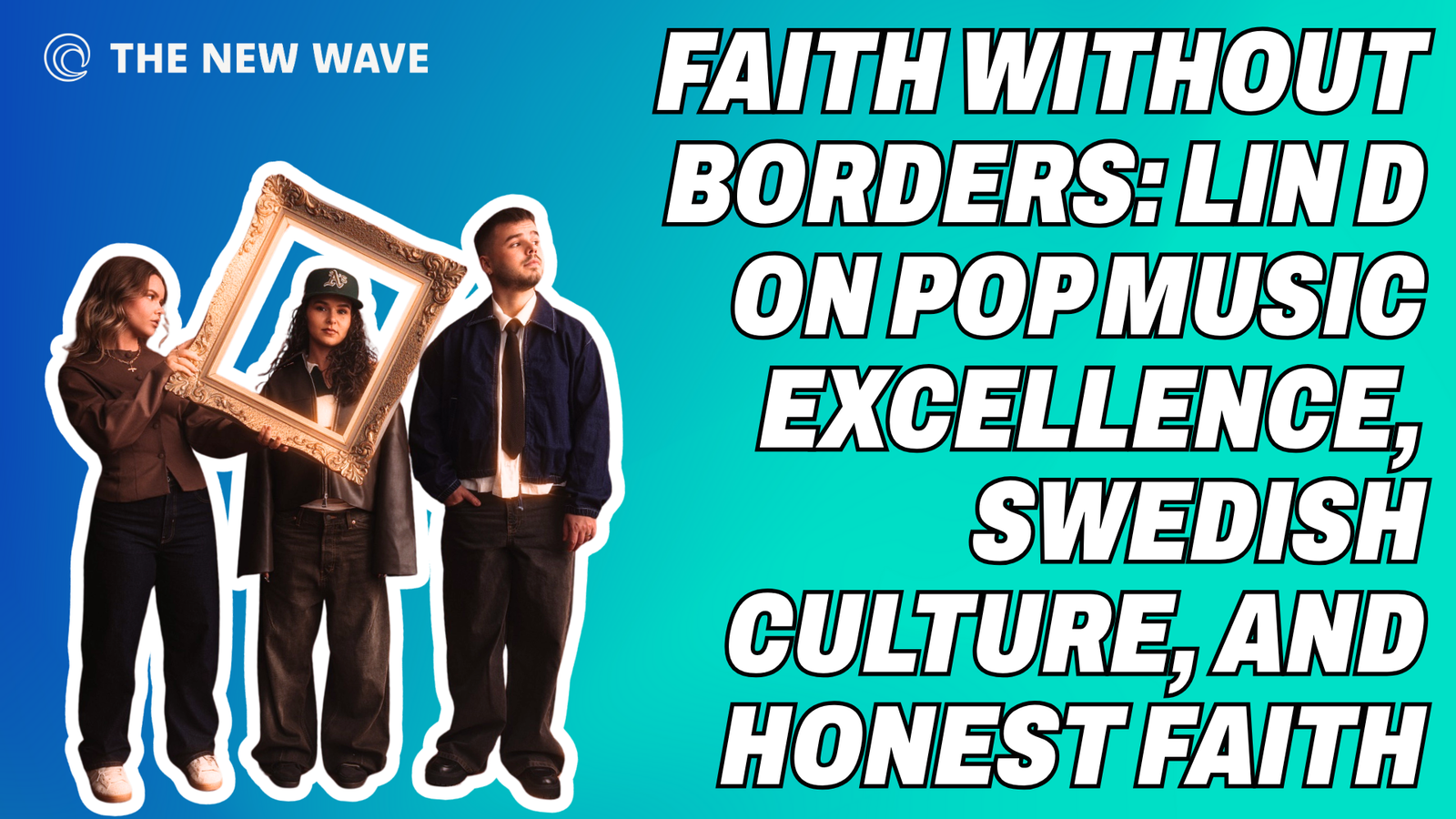
Faith Without Borders: Lin D on Pop Excellence, Swedish Culture, and Honest Faith
Three siblings from Sweden are redefining what it means to create art that’s holy, honest, and heard around the world.
1) Who Is Lin D? / Origins
Drew: Well, I'd love to jump in, I guess the obvious place to start off is who are you, who is Lin D? I’d love to hear a backstory—how did the band Lin D form? Why did y’all start an artist project?
Dennis: Yeah. So we're three siblings from Sweden. Lindéh is our last name in Swedish. So when you say it in English, it's “Lin D.” I'm Dennis, the oldest, 26.
Emmy: I'm Emmy, 23.
Ella: And I'm Ella, I'm the youngest one. I'm 21.
Emmy: We started out actually doing Christian kids music when we were kids. We traveled with our whole family doing Christian family services and all around Christian conferences, mostly in Sweden, but a little in Europe. We did that for many years. We did six albums with Christian kids music, mostly in Swedish. But then as we grew older, we wanted the music to grow with us, because that was very connected to family and kids. So we started Lin D, which is more of a pop, R&B, Christian music act. We’ve been doing that since like 2017, 2018.
Drew: Very cool. So y’all have been doing it for a little bit.
All: Yep.
2) Sound & Influences
Drew: I love that you mentioned the sound of the project. I’m hearing a lot of different sonic influences in terms of production and melodies. Could you pick out a few main musical influences—producers, artists, songwriters?
Ella: When it comes to songwriting, we’re very heavily influenced by Sweden and the songwriters who come from Sweden, like the pop melodies from Max Martin, Shellback… we have all those legends in the songwriting industry. We like to think a lot about creating good hooks and things that catch people’s attention, and just what we enjoy listening to ourselves. We’re heavily influenced by the Swedish scene.
Dennis: And we grew up listening to a lot of gospel music like Kirk Franklin, Israel Houghton, Mary Mary, and stuff like that. So it’s a blend of those two worlds. That’s what we try to do. I would say Jon Bellion would be up there, for production and songwriting.
Emmy: Probably Max Martin too. Dennis is our producer, so he produces everything.
Dennis: In general music, we’ve always been fans of Justin Bieber, someone who does R&B, pop, and dance.
Ella: Ariana Grande is also a very good reference.
3) Writing & Production Process
Drew: I love that you mentioned Max Martin and the Swedish pop thing because, like, looking into the pop industry over the past 20 years, it’s all from Max. Like, nothing would sound the way it does without his melodies. But no one is really aware of that. And I’m sure people in Sweden are a little more aware of him. People in America are just kind of like, “This is what music sounds like. It’s the way it is.” And it’s like, that is the lineage. So that’s really cool. And I can hear the Bieber and the Grande in there. Y’all have similar, like, vocally, I’m hearing some very pure, very clean vocals, which I would characterize for both of those artists.
Drew: That’s also something I noticed on y’all’s track list—was the whole thing completely self-produced, self-written?
Ella: Yeah so us three, we’re the only writers on the whole project. We wrote everything in this room. Like, our home studio in Sweden.
Drew: I love that. Okay, what was the thought process behind keeping it just the three of y’all?
Dennis: I don’t think we had a specific thought on it. I just think it was the simple fact that we’re just here in Sweden. We’ve been to Nashville a few times for writing trips and stuff, but during this period when we did these songs, last year, we were just in Sweden. So, I mean, we could have done some Zoom stuff or reached out to people in Europe, but we just got in—we had a period when we wrote every day for two, three months, just getting a bunch of ideas out, and all of these songs came from that period. : And that was just the three of us. So it wasn’t like a strategy, just intentional.
Ella: It wasn’t like, “Oh, we’re going to have no influence from anyone.” It was just what we had.
Drew: No, that’s great. Very cool. That makes sense. That’s so impressive. It sounds amazing, Dennis. I’m very impressed by the production, like it sounds—the whole thing’s very cinematic. It’s big, like I can hear the gospel, Kirk Franklin in there, but also some really—the drops and the swells and the beats you’re choosing. I’ve been listening to the project over and over again. Each song has different, like, it’s bigger and it’s smaller, and it just flows so well.
Dennis: Thank you. Thank you. I appreciate it.
Drew: Absolutely. And the melodies and lyrics and all of it. I’m just, like, clearly very impressed with the project.
4) Christian vs. “Secular” Conversation
Drew: I’d love to circle back to, I guess briefly, when y’all were naming influences and people y’all listened to, it was a lot of, I guess, “secular” artists. And I think there are a lot of people that listen to Christian music and they’re like, “I would never listen to anything made by Max Martin or Bieber or Grande.” So I’d love to hear if y’all have any thoughts on that kind of “Christian” vs. “secular” thought process?
Dennis: I think, for me, first of all, since I’m a producer, the lyrics are like the last thing I listen to.
Emmy: That’s so crazy to me, because lyrics are what hit me first.
Dennis: I mean, I have tons of songs in my playlist that I don’t know even the theme or, you know, because I can listen to a song because of the drums or the bass or whatever. But I would say in general, like, I had a period when I was a teenager, late teenage years, when I listened to a lot of hip hop and didn’t really care about the lyrics, and I could feel that that affected me in my life. So I made a conscious decision to get more, like, better themes and better lyrics into what I listen to. But when it comes to influences when we create, I think that we, all three of us, try to—we listen to a bunch of different stuff, but we don’t listen to stuff that goes just blatantly against our beliefs.
Ella: We never really—we didn’t grow up having—I don’t think in Sweden in general, it’s more normal in America to be like, “I don’t listen to secular music.”
Emmy: I didn’t even know the word “secular” until a few years back.
Ella: But I think there’s a big cultural difference there too. I feel like when you have the spirit in you, you have discernment and you will know what’s affecting you and what’s healthy for you and what’s not, I think. And yeah, it’s also important to just check your spirit.
Emmy: I think that might be different for different people… as Dennis said, he doesn’t even listen to lyrics that much, so some type of music doesn’t really affect him that much maybe.
Dennis: But I hear when it’s like, okay, I can’t listen to this.
Emmy: I think as Ella said, you have to just check with your spirit and sometimes you feel inspired by something and you run with that specific thing. But yeah, we try to just check our hearts and take away the good parts.
Ella: I don’t think it’s that easy to say… like, it’s not black and white.
Dennis: I mean, yeah, we’re doing music, but if you’re playing soccer, you’re looking at Messi and Ronaldo because they’re the best. You want to get inspired by them because of their skills. If you’re a CEO, you’re looking at the best-run companies or whatever, and we try to get the best out of all the different inspirations. And then you just have to have the discernment what to pick and what not to pick.
Drew: I love all that. I’ve been wrestling with similar things because, as y’all could probably hear from how I was knowing all the names you were naming, I do not only listen to Christian music. I think what all of what y’all said is so valid—the discernment and prayerfully knowing what you should listen to and not is so important. But I think we really miss if we’re only listening to the positive, encouraging, upbeat Christian music and nothing else, because there’s so much to learn from all the other things. So that’s a really cool perspective.
5) Faith & Church Life in Sweden
Drew: Cool. Okay, I’d love to kind of shift into Sweden, Scandinavia, I guess more from a perspective of being Christians there and what that’s like. I got to travel out to Scandinavia this summer. So I was in Oslo for a few days, Stockholm for a few days, and then also Copenhagen. It was really, really cool to see y’all’s culture and it’s beautiful there. But while I was there, I was doing a lot of research on faith in Scandinavia and I was fascinated by that. So I guess if y’all could give a lay of the land of Christianity in Scandinavia or Sweden specifically, and what that looks like on a high level, and then also what that’s been like in y’all’s personal experiences.
Ella: You probably saw when you went to Oslo, Copenhagen, Stockholm, that the cities are filled with churches—there are churches everywhere. So like, maybe a hundred years ago, Sweden was a very Christian country.
Emmy: Everyone went to church because you had to.
Dennis: It was mandatory, pretty much. When you were born, you were automatically a member of the Swedish State Church.
Ella: But from that, the state has very much separated itself from the church. And Sweden as a country is one of the most secularized countries in the world. So when it comes to values and everything, it’s moved very much away from the Christian beliefs and it’s viewed upon as pretty old school and not very politically correc to be a Christian today, that’s pretty much a lot of the normal reactions from many Swedish people. When you say that you’re still a Christian, a lot of people are like, “Okay, you still believe in those fairytales?” pretty much.
Dennis: We don’t have that many big churches or Christian celebrities—mega churches are not a thing, celebrities or stuff like that. So it’s a different culture, but we grew up in it, so that’s what we know. But we have, like, in our hometown and in Sweden, a very solid community with Christian young adults and teenagers. We see stuff happening—definitely would love to see more, but there are definitely shifts in the last few years. I think more and more people are seeing that there’s more to life than just… I mean, in Sweden, everybody has a pretty high living standard, so a lot of people don’t need God in their life for material things and day to day. But I think people are searching, and we have a lot of people that are open and curious, and sometimes they search for other spiritual things and so we just try to be there and guide them to God.
Ella: Now I think, since maybe more our parents’ generation in Sweden, they had more of a preconception of what Christianity is and what church is. But now I think it’s gone so far that our generation, they’ve never been to church. They don’t really have—maybe they’ve heard stuff from their parents or grandparents, negative or not negative about Christianity, but in our generation, not a lot of people know that much. So I think that could also be a reason that they don’t have any preconceptions of what it is to have a relationship with Jesus. So I think that’s why people are starting to actually explore it more.
Dennis: But it’s very common to be the only Christian in your class or your football team or whatever so the community is very important.
Drew: The churches there are beautiful and it kind of—like, that was one of the main things I tracked down while I was there was the cathedrals. Because we don’t have that in America as much… we’ve kind of lost a desire for beauty in some ways. That’s a whole other conversation, but it kind of grieved me that they are all museums now.
Ella: Yeah, a lot of churches are mostly like buildings now
Dennis: Some are active, or a lot of them are active. Like, we shot some videos for our song “Praise You” with Tarion. That was in a Swedish church, like in the middle of a square in Stockholm, pretty close to the Spotify headquarters. Beautiful church. And it’s open. We just asked if we could be there and they said yes.
Drew: So cool. I’ve been seeing in y’all’s comment section, people are like, “Is that a green screen?” and it’s not.
Ella: It’s not, it’s just Europe, I promise.
Drew: It was fascinating to see donation boxes of “help us keep the building open.” But that’s encouraging that a lot of them are active and y’all are seeing a shift. I think that’s representative of a global thing right now. Because culture globally has become post-Christian. It’s like a blank slate, like what you were talking about. Which has pros and cons, but a cool opportunity, I think.
6) Reception, Stories & “Too Christian / Not Christian Enough”
Drew: Going off of that, how have y’all seen your music and what y’all are doing connect with people specifically in Sweden and Scandinavia? Do you have any stories around that?
Dennis: I would say the reception is global due to social media. Our biggest audience is actually overseas—maybe USA and Brazil. So I wouldn’t say it’s a specific thing here in Sweden, but with the people that we meet… I got a message from an old classmate who said that she’s starting to come back more to faith and finding God again, and that the album has helped her. So that was really encouraging.
Ella: I think specifically in Sweden, a lot of people often comment on our music and after they’ve seen us at a show that we are very explicit with Jesus and talk about Jesus. We’re not hiding the fact that we’re Christians or that we’re very proud of our faith, and that’s not as common in Sweden actually. So I would get positively surprised if someone on TV would mention that they’re Christian or something like that, because the culture doesn’t really allow it in the same way as in America.
Emmy: But with that said, from friends who are not Christian here, people that we know who don’t really share our faith, they are so positive to what we’re doing and they support it. They think it’s cool that we write about our beliefs, and maybe they don’t think the same thing, but they’re still supportive and like the music and stuff, and they think it’s cool. That makes us happy.
Dennis: I mean, our view before has been a little bit that in the US we’re not Christian enough with the music, and in Sweden we’re too Christian, so we kind of fall in between somewhere there. But I haven’t felt that with this album as much. I would say it’s more like it’s resonating with people. The lines have been drawn out more.
Ella: When we wrote the lyrics to this whole project, not once did I think about, “Oh, how is this going to be? Is this too much Jesus? Or is it too little?” We just wrote whatever was on our hearts and from our life experiences.
Drew: I love all of what y’all just said. That’s fascinating—the “too Christian, not Christian enough” thing. It sounds like you’re saying “people have become more receptive to it.” Is that fair?
Dennis: Yeah, I’d say so. Or like, it’s not as—not that it was extreme before, but we could hear that more before, I feel like. Maybe it’s also due to, as you said, what’s going on in the world right now, that people are like—we see a lot of Christian artists just popping off. You see a lot of non-Christian artists going into more topics like that in the music. So I feel like those go hand in hand—how people are listening to music at the moment and what they want from the music they listen to. So maybe that has something to do with it as well.
Drew: I agree. There’s a crazy shift going on in Christian music in general. That’s the whole point of The New Wave and everything I’m doing—covering people like y’all who, I think two or three years ago, people would’ve heard it and been like, “This doesn’t sound like Christian radio, so we don’t want to listen to it.” But I think the walls have been broken down in some crazy ways. Even specifically on the pop side, like Forrest Frank obviously has taken kind of an 808s hip-hop driven production style and brought it into CCM. So people are just more receptive to that. And then there’s more people like y’all who are just making music in your houses and putting it out on social media, and people love it because it’s better than the other stuff. So it’s working. It’s just fun to see. So I think more and more, I’m excited to see artists who are Christian, instead of feeling like they have to write something a specific way, just doing what y’all did—making the music that you like and what moves you.
Emmy: And I want to say, though, that we love when people make music that honors God. We like that the perspectives are being widened and that it’s not forced into any sound. But if that—like, we are very, like, we want to champion people making the music that they love and that they want to make. And if that is CCM and Christian music like that, then we think that’s beautiful. We love a lot of CCM songs too.
Dennis: We need everything.
Ella: I think that music that doesn’t sound like maybe the typical thing that Christian music is, may reach a certain audience that wouldn’t listen to that music. So there’s a purpose for all of the genres. I don’t think God’s restricted to only one genre.
Emmy: But then CCM also reaches a lot of people, so we just want to be a part of widening things, but we also want to honor the songs that have been created for so many years.
Drew: I love that. Yes. Thank you for that. With this whole New Wave thing, I kind of tend to accidentally, subliminally bash some of the the old industry, but yes, I agree. There’s an audience. Obviously it exists because it’s working and it’s encouraging people.
Emmy: But it is cool to see that it’s being widened.
Drew: Yeah, exactly. I love that we have Christian music for kids and for parents and minivans, but it’s also like, what about me? What about all my classmates and my people? It’s supposed to be for everyone. That’s why I love the shift and what y’all are doing, and all of that.
7) Global Audience (Brazil, etc.)
Drew: Very brief side tangent—I was looking at y’all’s stats and Brazil is like y’all’s number two audience, which I’m fascinated by. Do you know how you made it in the Brazilian algorithm or what’s going on there?
Dennis: I feel like, first of all, there’s a lot of Christians there that listen to Christian music and they’re very interested in music in general. We’ve understood that they’re very musical people that love chords and melody and rhythm. I mean, if you listen to Brazilian music, like the national music there, there’s a lot of great stuff and a lot of great musicians. But yeah, I think they just appreciate music. Of course, people from all countries do, but they, as a people, are really champions of music in general. And we can see in our comment section, they’re also very proud because they always comment with their flag or “Come to Brazil!”
Ella: They’re a very good marketing team for their own country. They’re good at being enthusiastic about the music and the artists they listen to.
Drew: Fascinating. In doing this New Wave thing, I’m seeing a lot more—I mean, I’ve always listened to people from all over, but specifically, it is fascinating to be like, there’s a Christian pop/R&B group in Sweden and they’re being listened to in Brazil. I’m connecting with all these UK artists, and someone who makes Christian music in India followed me yesterday and I looked at their page and I’m like, “I love this.” I’m seeing—it’s so global, you know? I think Christian music has been specifically very American, and so it is cool to see it break out of that because the church is a lot more global than people here realize.
8) Favorite Tracks
Drew: I guess to close, we’ll end with the album because I feel like we talked about the album, but could have talked about it more. Briefly, favorite track for each of y’all and why that’s the case?
Emmy: I think from “Honest to God,” I’m going to say “Yahweh.” It’s the last song on there, and I just love the vibe and the melodies that we wrote to that song too. Also, the message is just so uplifting. It’s about setting your eyes on heaven and that one day God’s going to wipe every tear away and we’re going to just celebrate in heaven with the saints. I think that’s my favorite one just right off the bat, but it’s very hard picking—like, it’s like everyone says, picking your favorite child. I don’t have kids, but I would imagine that’s what it feels like. But right off the bat, it’s “Yahweh,” I think.
Ella: For me, just based off of when we wrote the song and just the feeling we had right after we listened to the demo in the studio, “Praise You,” the first track of the album, that was something special. The reception of that song has been very cool to see too. It’s featuring Terrian, that was amazing to get her on the song. There’s just something about the melodies and the beat to that song—it really speaks to me a lot. So that’s my favorite, I think.
Dennis: It’s hard to choose, but as a producer, I would say “Lies” is my favorite production on the album. But yeah, you love them all for sure.
Drew: I’m sure that was like trying to pick your favorite child. But those are all great ones to highlight. I love the intentionality of ending with “Yahweh.” It’s like a triumphant moment, especially right after “Lord, I Need You,” where it’s like, “God, I am down bad and I’m crying out,” and then it’s just like, “We’re happy.” So all great tracks—“Lies” production-wise was really cool. I definitely agree with that.
9) Album Takeaway / Final Thoughts
Drew: I guess to close, is there one takeaway or key theme of the album that y’all are hoping people hear from it? And it doesn’t have to be the main thing—if there’s just a smaller thing, that’s great too.
Dennis: Obviously it’s called “Honest to God,” but I would say if there’s any sum up, it’s that God is with you through your ups and your downs, and you can come to him with whatever is weighing you down—if that is the devil’s lies or your own foolish mind. Or if you have questions, like in “Lord, I Need You.” But he’s also with you in the great moments when you just feel like praising him or lifting up his name, because we’re thankful and grateful. So that would be the short summary, very general sum. Actually, in our Bible plan that’s tied to the album, you’ll get more of a description of every song and how they came about and the themes and stuff. You can find it on the YouVersion Bible app. So I would encourage people to get the whole heart behind the project there.
Emmy: And I think just overall, we have experienced and we want to tell people that God can handle your feelings. All of our feelings go up and down and sometimes they lie to us, and sometimes feelings are great. But God can handle and meet you wherever you are.

Drew Kedersha
Drew Kedersha is the founder of The New Wave, a platform highlighting boundary-pushing Christian music. Currently based in Nashville, TN, Drew spends his time writing music, listening to a lot of podcasts, and going to class occasionally. Mostly, he just wants the good stuff to get heard.